
11 September 2025
How the Gravity Fail-Safe Mechanism Works in Fire Curtain Systems
The single most important reliability feature of an automatic fire curtain isn't its motor - it's what happens when the motor stops working. Here's how gravity fail-safe deployment functions.
Every automatic fire curtain has to solve the same fundamental reliability problem: it must remain retracted and out of the way during normal building operation - potentially for years - and then deploy reliably, every time, the moment it is needed, including in scenarios where the building's power supply has failed. BÖLDT's automatic fire curtains solve this through gravity fail-safe deployment, a mechanism that inverts the usual relationship between power and safety-critical action.
Motor-Held Operation
During normal operation, the curtain fabric is wound onto a roller within the head box, held in its retracted position by an electric motor and brake assembly. The motor is energised continuously (or holds position via a brake when not actively winding) to keep the curtain retracted. This is the inverse of how most motorised building products work - a powered gate or shutter typically requires power to move and stays in its last position when power is lost. A gravity fail-safe curtain requires power to stay retracted, and moves - deploys - the moment that power is removed.
What Happens on Power Loss
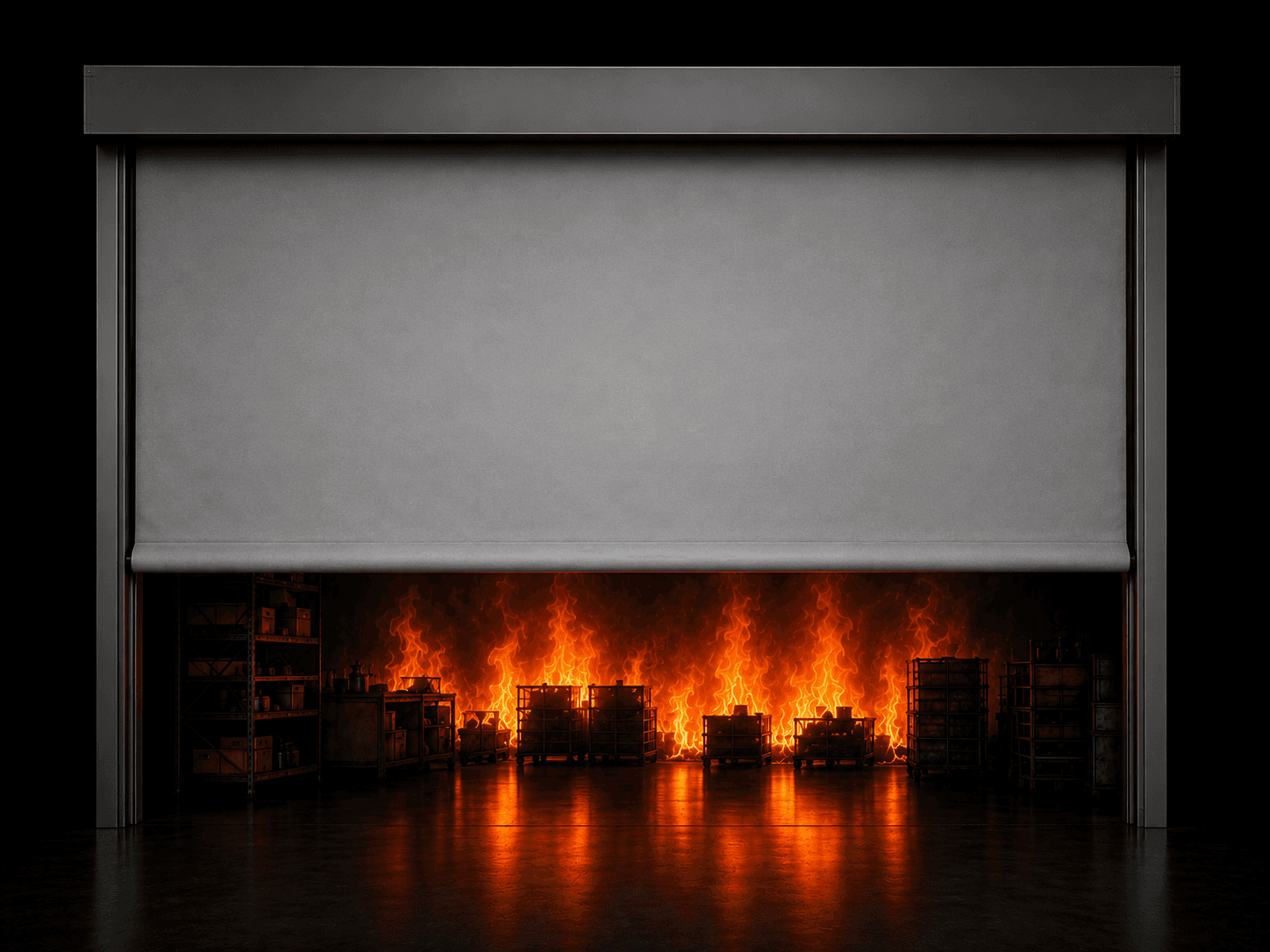
On receipt of a fire alarm signal, the motor controller releases the brake holding the curtain roller, and the fabric descends under its own weight, with the descent rate controlled by a governor mechanism to ensure a smooth, even deployment rather than an uncontrolled drop. Critically, the same release occurs if the building experiences a total power failure - whether or not a fire alarm signal was ever sent. The motor and brake require power to hold the curtain up; remove that power for any reason, and the curtain deploys.
Why No Battery Backup Is Required
Many life-safety systems rely on battery backup to maintain function during a power failure - emergency lighting, fire alarm panels, smoke extraction fans. Battery backup systems introduce their own maintenance burden: batteries degrade over time, require periodic testing and replacement, and represent a potential single point of failure if not maintained. Gravity fail-safe fire curtains sidestep this entirely - because deployment is the curtain's response to losing power, rather than an action that requires power (even backup power) to execute, there is no battery to maintain, test, or replace as part of the curtain's deployment reliability.
Why This Matters for Specifiers
From a specification and lifecycle perspective, gravity fail-safe deployment means a fire curtain's most safety-critical function - deploying when needed - has no dependency on a maintained backup power system. Commissioning and periodic testing still need to confirm the motor, brake, governor and fabric are in good working order (a curtain that has seized due to corrosion or debris in the guide rails will not deploy correctly even under gravity), but the fundamental reliability of the fail-safe mechanism does not degrade in the way a battery does. This is a key reason gravity fail-safe deployment is standard across BÖLDT's automatic fire curtain, smoke curtain, accordion and egress curtain ranges.