30 June 2026
EN 12101-1 Explained: Smoke Control Curtains and Barriers
EN 12101-1 is the standard behind every BÖLDT smoke curtain classification. Here's what it covers, how it differs from EN 1634-1, and why smoke control is treated as its own discipline.
Smoke, not flame, is responsible for the majority of fire fatalities, which is why smoke control is treated as a distinct engineering discipline from fire resistance, with its own dedicated European standard: EN 12101. Part 1 of this multi-part standard specifically addresses smoke barriers, including smoke curtains, and sets out the performance requirements a product must meet before it can be classified and specified as a smoke control element.
How EN 12101-1 Differs From EN 1634-1
EN 1634-1 tests fire resistance - a sample's ability to resist flame penetration, heat transfer, and radiant heat over time in a furnace. EN 12101-1 tests something related but distinct: a smoke barrier's ability to deploy reliably and contain the movement of smoke, including at elevated temperatures, without necessarily being exposed to the same direct flame conditions as a fire-resistance test. A product can be classified under EN 12101-1 as a smoke barrier without holding an EN 1634-1 fire resistance classification, and vice versa - many BÖLDT fire curtains hold both classifications, because they are designed to perform both roles, but the two tests examine different failure modes.
What the Test Examines
An EN 12101-1 test assesses the smoke barrier's reliability of automatic deployment - does it activate correctly and consistently when triggered - and its ability to resist smoke leakage at the edges and across the barrier surface, typically at an elevated temperature representative of a developing fire. The result is expressed as a classification referencing the duration, in minutes, for which the barrier's smoke control performance is demonstrated, alongside criteria covering repeated operation, since smoke curtains in some applications may be required to deploy, reset and redeploy multiple times over their service life without degradation.
Where EN 12101-1 Classified Products Are Specified
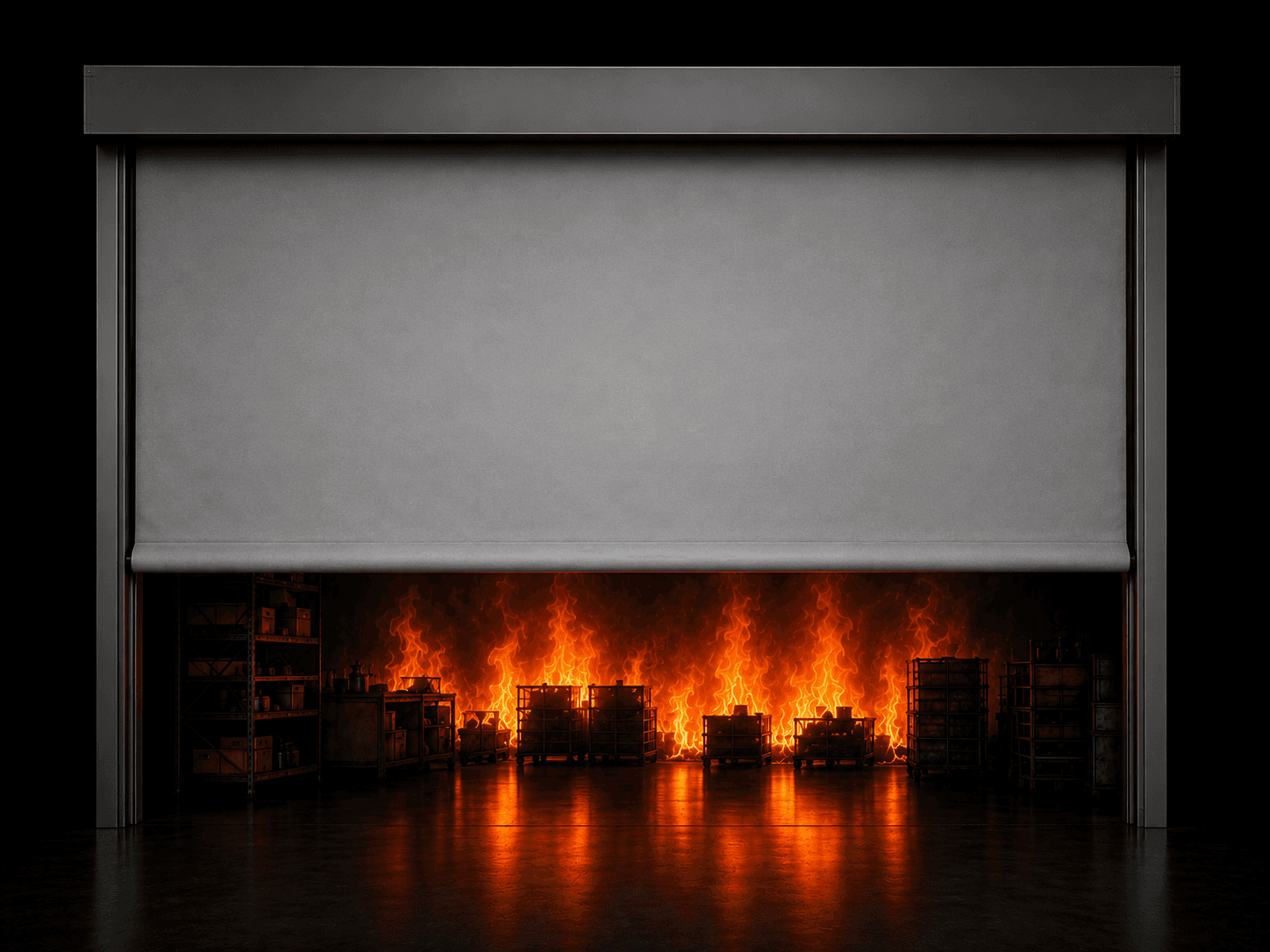
Smoke curtains classified under EN 12101-1 are specified wherever a building's smoke control strategy requires a barrier to divide a large volume into smoke reservoirs, or to protect an escape route from smoke ingress, without necessarily requiring the full fire-resistance performance of a fire curtain. Shopping centres, transport interchanges, large office floor plates and atria are typical applications, where the smoke control strategy - often developed with reference to BS 9999 - defines reservoir boundaries and extraction points, and EN 12101-1 classified curtains form the physical boundaries the strategy depends on.
Gravity Fail-Safe Deployment and EN 12101-1
Because a smoke control strategy is often relied upon in the earliest minutes of a fire event - before occupants have necessarily evacuated and before mechanical extraction has fully engaged - reliability of deployment is central to what EN 12101-1 examines. BÖLDT's smoke curtains use the same gravity fail-safe deployment mechanism as our fire curtain range: the curtain is held retracted by a powered brake and descends under its own weight the moment power is lost, whether from a fire alarm signal or a total power failure, removing dependency on battery backup for the deployment function itself.
Specification Guidance
- -Confirm whether your project's smoke control strategy requires an EN 12101-1 classified barrier, an EN 1634-1 fire-resistant curtain, or both, before finalising the product specification.
- -Reference the specific classification and duration held by the product, not just 'EN 12101-1 compliant' as a general claim.
- -Coordinate smoke curtain deployment logic with the building's mechanical smoke extraction design - the two systems are typically designed together, not in isolation.
- -Confirm gravity fail-safe or equivalent reliable deployment is specified for any smoke curtain relied upon in the early stages of a fire event, before active systems have necessarily engaged.
BÖLDT smoke curtains are classified under EN 12101-1 and manufactured in-house, using the same gravity fail-safe deployment mechanism proven across our automatic fire curtain range.