
20 November 2025
Smoke Curtain Systems - How They Protect Escape Routes in the Critical First Minutes
Smoke causes more fire fatalities than flame. Smoke curtains buy time by containing and directing smoke away from escape routes - here's how classification under EN 12101-1 works.
In most building fires, smoke - not flame - is the primary hazard to occupants attempting to evacuate. Smoke spreads faster than fire, reduces visibility to near zero within a corridor or stairwell in a matter of minutes, and is toxic well before temperatures become directly life-threatening. Smoke curtains are a category of motorised curtain specifically designed to address this hazard in the critical early stages of a fire, before active smoke extraction systems may have fully engaged.
How Smoke Behaves in the Early Stages of a Fire
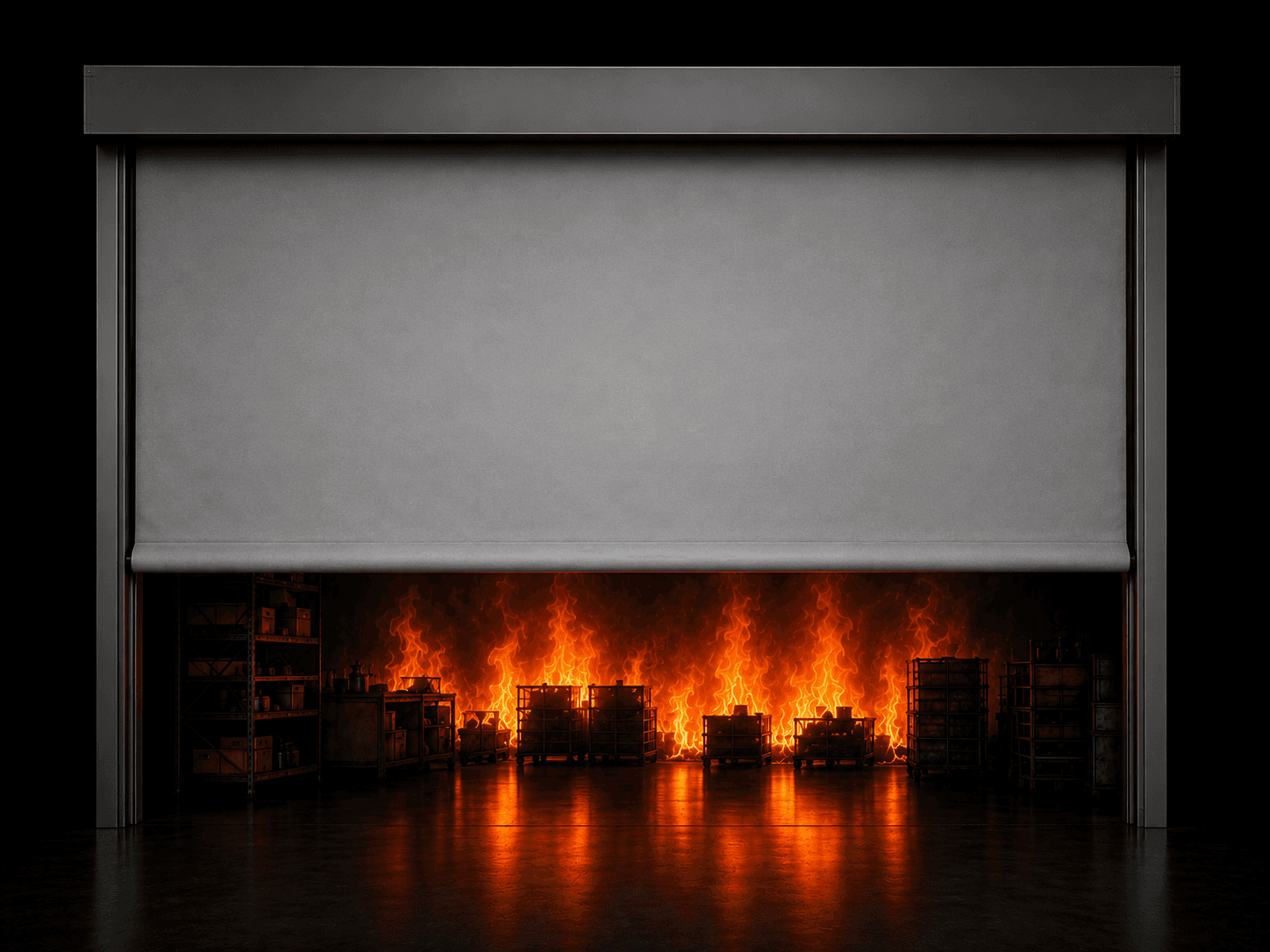
Smoke from a developing fire rises due to buoyancy and spreads laterally once it meets a ceiling or soffit, forming a smoke layer that descends over time as more smoke is produced. In an open-plan space or one connected to other areas - corridors, atria, stairwells - this layer can spread well beyond the room of origin within minutes, contaminating escape routes that occupants on other floors or in other zones are relying on. The objective of a smoke curtain is to physically interrupt this lateral spread, containing the smoke layer within the zone of origin or directing it towards a designated extraction point.
Classification Under EN 12101-1
BÖLDT smoke curtains are classified under EN 12101-1, the European product standard for smoke barriers and smoke curtains. The classification relates to the curtain's reliability of automatic closing under the standard's test conditions, and the associated time period indicates the duration, in minutes, for which this performance is demonstrated. Unlike the E/EW/EI system used for fire curtains under EN 1634-1, EN 12101-1's classification system is specific to smoke and heat control products - it tests the curtain's ability to deploy reliably and contain smoke movement, rather than withstand direct flame exposure to the same degree as a fire-rated barrier.
EN 12101-1 Requirements
EN 12101-1 is a multi-part European standard defining performance requirements for smoke and heat control systems in buildings generally - smoke curtains are one product category addressed within this framework. Certification to EN 12101-1 demonstrates measurable performance in real fire scenarios, supporting both life safety strategies (keeping escape routes clear of smoke for longer) and regulatory compliance under BS 9999 and Approved Document B guidance. As with BÖLDT's fire curtains, smoke curtains incorporate gravity fail-safe deployment as standard - ensuring the curtain deploys even in the event of total power failure, when active smoke extraction fans may also be affected.
Channelising Smoke to Extraction Points
In many designs, smoke curtains work in concert with mechanical smoke extraction - the curtain's role is not necessarily to stop smoke spread entirely, but to channel it towards extract points designed to remove it from the building. By dividing a large volume into smoke reservoirs using curtains deployed at defined boundaries, the extraction system can be sized and positioned to deal with smoke from one reservoir at a time, rather than the entire connected volume simultaneously. This is particularly relevant in shopping centres, transport interchanges and large office floor plates with open-plan layouts, where smoke curtains define the reservoir boundaries that the mechanical ventilation strategy is designed around.