24 June 2026
What Is a Fire Door? A Plain-English Introduction
Fire doors look ordinary but are engineered to do a specific job: hold back fire and smoke for a set period. Here's what actually makes a door a fire door, in plain terms.
A fire door looks, from a distance, much like any other internal door. The difference is entirely in what it's built to do: when closed, a fire door is engineered to resist the passage of fire and smoke for a specified period of time, buying occupants time to escape and firefighters time to respond, while limiting how far a fire can spread through a building.
A Fire Door Is a Complete Assembly, Not Just a Panel
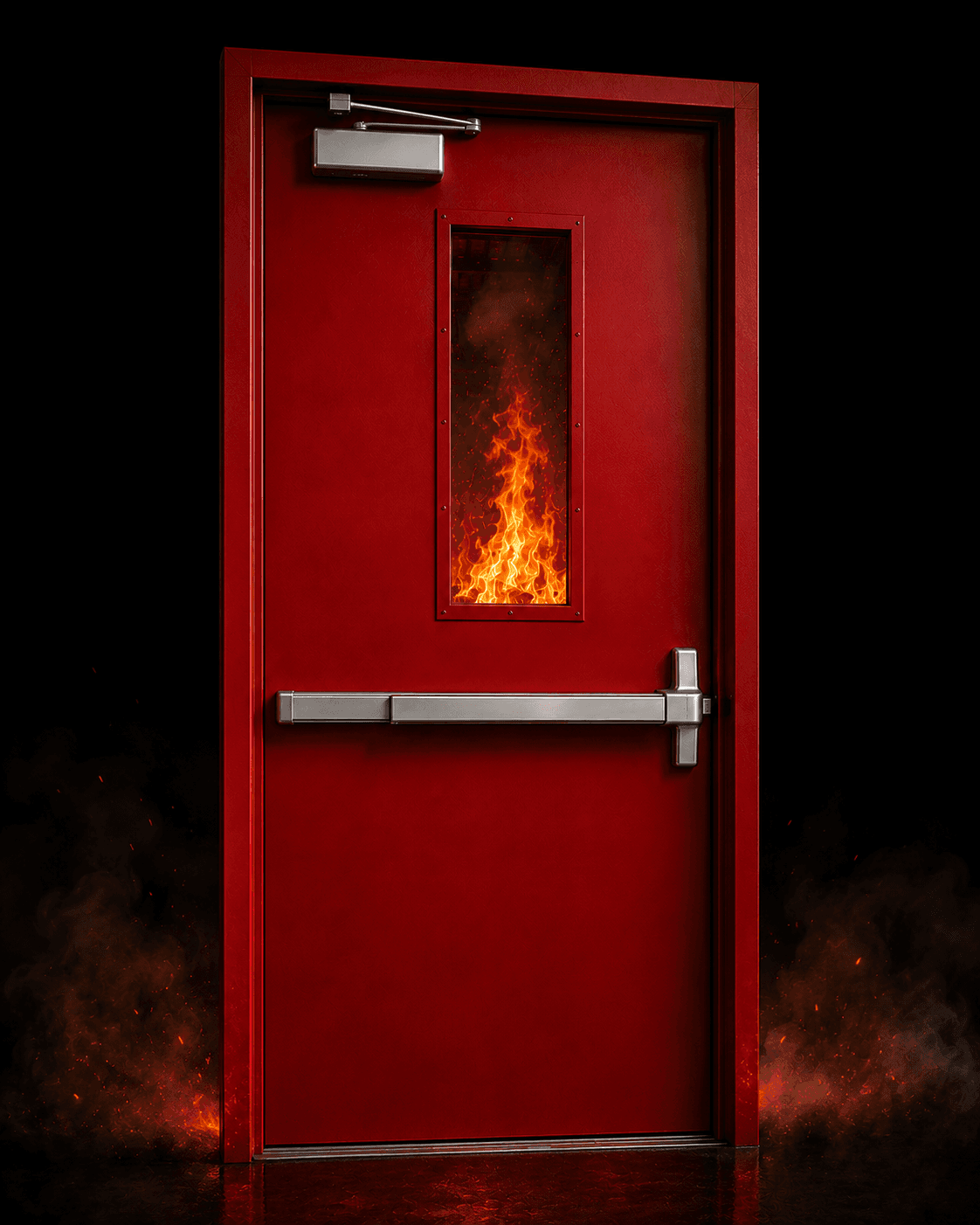
The single most common misunderstanding about fire doors is treating the door leaf - the flat panel that swings open and shut - as the fire door itself. In reality, a fire door is a complete tested assembly: the leaf, the frame, the intumescent and smoke seals around its edges, and the hardware fitted to it (hinges, closer, latch or lock) all form part of the same tested unit. Swap out a hinge for an unrated one, or fit a letterbox or vision panel that wasn't part of the original test, and the assembly's fire performance is no longer proven - even though the door leaf itself is unchanged. This is why fire door specification and maintenance guidance consistently uses the term doorset: a complete unit supplied and tested together, rather than a door leaf that happens to be fire-rated.
What Actually Happens in a Fire
Two components do most of the work. The door leaf and frame themselves are constructed to resist burning through or losing structural integrity for the rated period. Around the edges of the door, intumescent seals - strips of material that are inert at room temperature - react to heat, typically starting to expand somewhere in the range of 150°C to 250°C depending on the specific compound, swelling to many times their original thickness and sealing the gap between the door leaf and frame as it starts to distort under heat. Separately, smoke seals (often combined with the intumescent seal in a single strip) block the passage of cool smoke even before the fire reaches a temperature that would trigger intumescent expansion, since smoke is often the more immediate threat to escaping occupants.
Why Fire Doors Have to Stay Shut
A fire door can only do its job if it's closed. This is why fire doors are fitted with self-closing devices and carry the familiar blue "Fire Door Keep Shut" signage - a mandatory instruction sign under UK safety signage regulations, not a suggestion. A fire door wedged open, or with a failed or disconnected closer, provides no protection at all during a fire, regardless of how it's rated on paper. This is also the single most common finding in fire door inspections and one of the specific issues the Fire Safety (England) Regulations 2022 targeted directly, following evidence to the Grenfell Tower Inquiry about self-closing failures.
Fire Doors vs Fire Exit Doors - Not the Same Thing
It's worth being clear about a related but different type of door: a fire exit door is the final door on an escape route, leading directly to a place of safety outside the building. Its job is to open easily and let people out fast - it is not required to be fire-rated, and in fact prioritising an easy, unimpeded exit over fire resistance is the correct design choice for that specific door. A fire door, by contrast, is typically found inside the building - on stairwells, between compartments, at flat entrances - and its job is the opposite: to stay closed and resist fire, not to be flung open for evacuation. Confusing the two in a specification or risk assessment is a genuine and fairly common error.
The Basics, Summarised
- -A fire door is a complete tested assembly (leaf, frame, seals, hardware) - not just the door leaf on its own.
- -Intumescent seals expand under heat to close the gap between leaf and frame; smoke seals block smoke passage separately and earlier.
- -A fire door only works when closed - self-closing devices and 'Keep Shut' signage are functional requirements, not decoration.
- -A fire exit door and a fire door serve opposite purposes: one prioritises fast escape, the other prioritises staying shut and holding back fire.
- -Fire doors are rated by time (e.g. 30, 60, 90 minutes) - the subject of a dedicated explainer elsewhere in our Knowledge Centre.
BÖLDT supplies complete fire door assemblies, tested to EN 1634-1 and classified to EN 13501-2, with all hardware and seals matched to the tested configuration.